

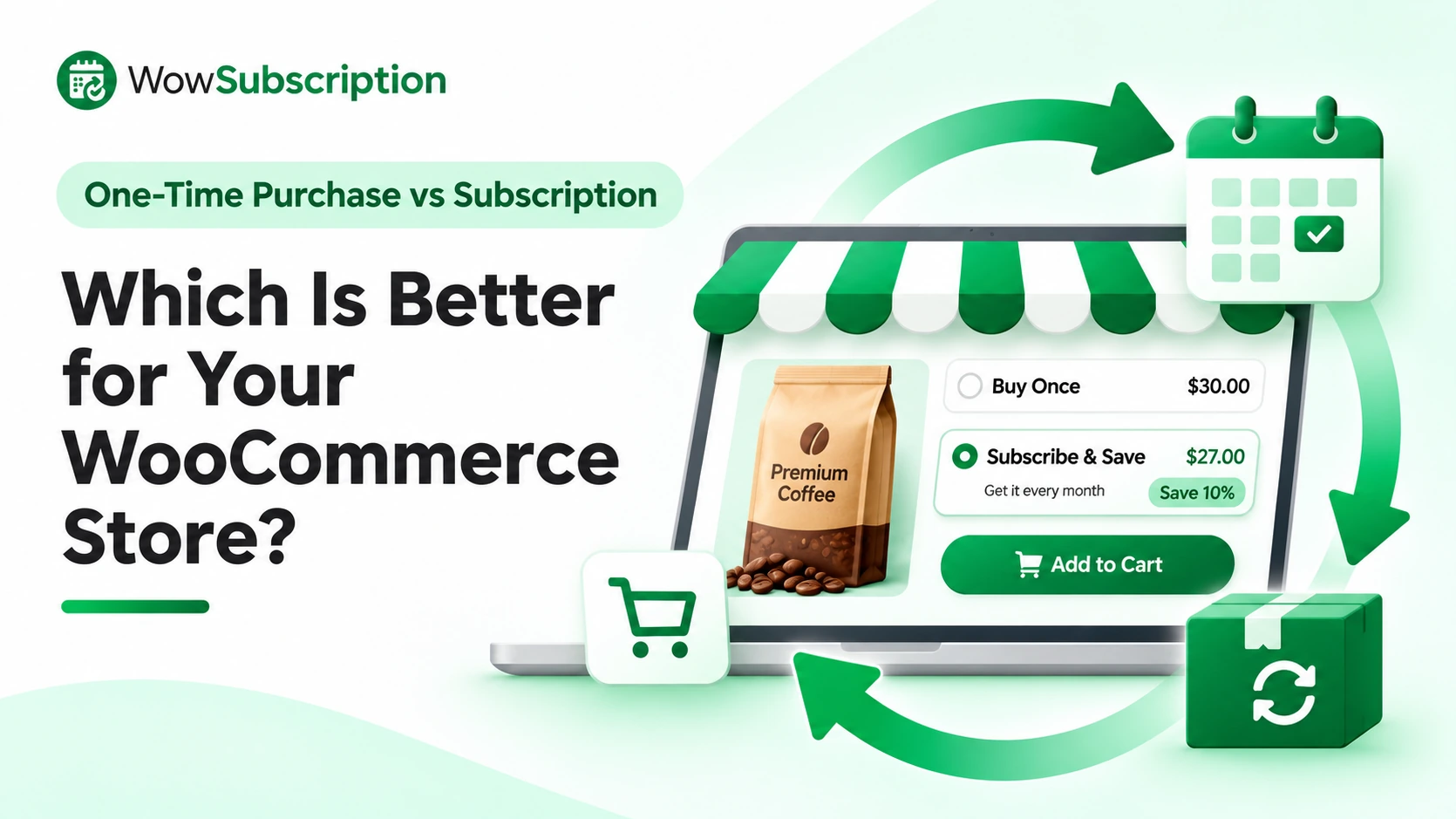
Choosing between a one-time purchase and a subscription can affect how customers buy from your WooCommerce store, how often they return, and how much you earn from each sale.
A one-time purchase usually makes more sense for products customers buy occasionally or when needed. A subscription is better suited to products customers regularly use and need to reorder. You can also offer both options if your products and customers support that flexibility.
But recurring payments don’t automatically mean higher profits. Before choosing a model, you need to consider customer demand, repeat purchases, discounts, and the cost of fulfilling each order.
Let’s compare the options from a WooCommerce store owner’s perspective.
One-Time Purchase vs Subscription: Key Differences
The main difference between a one-time purchase and a subscription is how customers place orders and pay for products.
With a one-time purchase, customers pay for an order without committing to future purchases. They can return to your store whenever they want to buy again.
With a subscription, customers agree to recurring payments for products or services, usually on a weekly, monthly, or yearly schedule. Each renewal continues according to the subscription terms unless the arrangement changes or ends.
Here’s how the models compare:
| Factor | One-Time Purchase | Subscription |
|---|---|---|
| Payment | Customer pays for each separate order | Payments recur according to a schedule |
| Customer commitment | No ongoing purchase commitment | Ongoing until cancellation or expiration |
| Repeat purchases | Customer places another order | Renewals occur under the subscription terms |
| Revenue predictability | Depends on new and returning orders | Scheduled renewals provide more visibility, but payments aren’t guaranteed |
| Customer flexibility | Customers buy whenever needed | Customers follow an agreed schedule, subject to plan options |
| Store management | Manage individual orders | Manage orders, renewals, cancellations, and payment issues |
Neither model is universally better. The right choice depends on what you sell and how your customers prefer to purchase it.
When Is a One-Time Purchase Better for Your Store?
A one-time purchase is generally better when customers don’t need your products at regular intervals.
Suppose your WooCommerce store sells kitchen appliances. Someone purchasing a blender probably won’t need another one next month. Offering a monthly subscription for that product wouldn’t make much sense.
One-time purchases are particularly suitable when:
- Products have irregular demand: Customers buy home decor, gifts, or accessories when needed rather than on a fixed schedule.
- Customers prefer flexibility: Buyers can try your products without committing to future payments.
- Products have long replacement cycles: Durable items like furniture, appliances, and electronics don’t require frequent replacement.
- Demand or inventory is unpredictable: You don’t need to commit to recurring deliveries you may struggle to fulfill.
One-time purchases also work for products customers regularly reorder but prefer to buy on their own schedule.
For example, someone may purchase skincare products every few months without wanting an automatic renewal. You can still encourage repeat purchases through reminders, relevant offers, and a convenient shopping experience.
The important distinction is that one-time purchases don’t necessarily mean one-time customers.
When Should You Choose a Subscription Model?
A subscription model makes more sense when customers need something repeatedly and prefer receiving it or accessing it on a regular schedule.
For example, a customer who buys the same coffee beans every month might appreciate automatic deliveries instead of placing a new order each time.
But subscriptions aren’t limited to products that customers use up. They can also work for ongoing services and recurring business purchases.
Here are some examples worth considering:
| Product or Service | Why a Subscription Might Work |
|---|---|
| Coffee, pet food, skincare, and other consumables | Customers regularly run out and need replacements. |
| Car maintenance services | A car owner might purchase the vehicle once but pay for a recurring maintenance plan covering scheduled services. |
| Wholesale supplies | Retail shop owners may need regular deliveries from wholesalers to refill inventory. |
| Memberships and digital services | Customers pay regularly for continued access or ongoing benefits. |
Consider the wholesale example. A retailer may purchase the same products from a wholesaler every month to keep the shelves stocked. A recurring supply arrangement could save time for both businesses by reducing repetitive ordering.
However, wholesale buyers may need different quantities depending on sales and seasonal demand. A fixed subscription only makes sense if its schedule, quantities, and terms match their actual needs.
The same principle applies to car maintenance. The car itself isn’t something most customers replace regularly, but scheduled maintenance can create an ongoing service relationship.
The key is to identify a recurring customer need, not simply a product you want to sell repeatedly.
Before introducing subscriptions, check whether customers buy frequently enough, whether you can deliver consistently, and whether the recurring price covers your costs. Remember that customers may cancel, and renewal payments can fail.
Which Model Generates More Profit After Costs?
Subscriptions can bring in more orders over time, but that doesn’t always mean you’ll earn more money.
Let’s compare both models using a simple WooCommerce store example.
Compare Contribution Over the Same Period
Imagine you sell premium coffee beans in your WooCommerce store.
You offer two purchasing options:
- One-time purchase: $30 per bag.
- Monthly subscription: $27 per bag, with a 10% discount.
Now suppose each bag costs you $17 in total: $12 for the coffee, $4 for packaging and fulfillment, and $1 for payment processing.
After paying these costs, you’re left with:
- $13 from every one-time order ($30 − $17).
- $10 from every subscription order ($27 − $17).
So, you earn $3 more from an individual one-time purchase.
But what happens when customers buy again?
Let’s say you have two hypothetical groups of 100 customers. One group purchases coffee normally, while the other subscribes to monthly deliveries.
Here’s what happens over three months:
| One-Time Purchase | Subscription | |
|---|---|---|
| First month: Paid orders | 100 | 100 |
| Second month: Paid orders | 35 | 80 |
| Third month: Paid orders | 30 | 65 |
| Total paid orders | 165 | 245 |
| Money left per order after costs | $13 | $10 |
| Total money left after order costs | $2,145 | $2,450 |
Notice the difference.
One-time purchases leave you with more money per order, but fewer customers place additional orders in this example.
Subscriptions leave you with less money per order because of the discount. However, more successful repeat payments mean the subscription group generates $305 more over three months.
This amount is called contribution. It’s the money remaining after the order costs we’ve included, not your final profit.
These are hypothetical numbers, not actual WooCommerce store results. They don’t include advertising, plugin costs, fixed business expenses, taxes, refunds, or other possible costs. Both groups start with 100 paying customers, but attracting those customers could cost different amounts.
What Happens When Renewals Fail or Costs Increase?
Now imagine that fewer subscribers continue paying.
Instead of 80 paid renewals in the second month and 65 in the third, your store receives only 60 and 45.
That means you receive:
- 100 initial subscription orders.
- 60 paid renewals in the second month.
- 45 paid renewals in the third month.
That’s 205 paid orders, leaving you with $2,050 after the $17-per-order costs.
Meanwhile, the one-time purchase group still generates $2,145.
Now the one-time purchase model performs better, even though subscribers still place more orders overall.
Higher costs can also change the result. If each subscription delivery costs an additional $2, the amount you keep per delivery drops from $10 to $8.
Even with the original 245 paid subscription orders, you would keep only $1,960 after those order costs.
Subscription cancellations and failed payments are also important to monitor. Stripe’s guide to subscription churn explains how both voluntary cancellations and payment-related issues can affect recurring revenue.
The lesson is simple: don’t choose subscriptions just because they promise recurring payments.
Look at how often customers actually pay, how many one-time buyers return, and how much money remains after fulfilling those orders. Then consider your other business expenses before judging overall profitability.
Can You Offer One-Time Purchases and Subscriptions Together in WooCommerce?
Yes. You can offer both one-time purchases and subscriptions for the same product in your WooCommerce store. This is commonly called a hybrid purchase model.
Suppose your store sells coffee. You could let customers choose between:
- Buy Once: Purchase one bag for $30 without any recurring commitment.
- Subscribe & Save: Receive a bag every month for $27 until the subscription ends.
This gives occasional buyers the flexibility to purchase whenever they want, while regular customers can enjoy scheduled deliveries.
You can set up this purchasing option using WowSubscription, a WooCommerce subscription plugin.
WowSubscription includes an Allow one-time purchase setting that lets you offer a regular purchase option alongside a subscription plan. Customers can then choose how they want to purchase the product.
You can follow the WowSubscription plan configuration guide to learn more about setting it up.
Before launching, make sure your payment gateway and subscription configuration support your intended recurring payment process.
A hybrid model works best when customers genuinely want both options. However, offering subscriptions doesn’t automatically increase sales. Some customers may simply switch from full-price repeat purchases to discounted subscriptions without buying more frequently.
That’s why it’s important to evaluate customer demand and profit margins before expanding this model across your store.
Test Your Purchase Model Before Committing
You don’t have to introduce subscriptions across your entire WooCommerce store immediately.
Start with one suitable product and see how customers respond. This will help you understand whether subscriptions are worth expanding.
Start With a Product Customers Already Reorder
Start by reviewing your WooCommerce order history to identify products customers buy repeatedly. The WooCommerce Orders Report lets you filter orders by product and customer type, helping you investigate purchasing patterns.
Suppose you notice that many customers buy your coffee beans approximately once a month. That’s a reasonable product to test with a monthly subscription.
You could keep the regular Buy Once option and add a Subscribe & Save option for the same product.
This way, customers can choose what they prefer, and you can see whether they’re interested in recurring deliveries.
Pay attention to the usual reorder timing. If customers buy a product every six weeks, a weekly subscription probably won’t match their needs.
Give the test enough time for customers to complete a few renewal cycles. Initial subscription signups alone won’t tell you whether people want to continue.
Measure Whether Subscriptions Actually Perform Better
After introducing the subscription option, review what happens.
You don’t need a complicated process to begin. Focus on these questions:
- Are customers choosing subscriptions? Check how many customers select Subscribe instead of Buy Once.
- Are subscribers staying? Check how many successfully pay for their next deliveries and how many cancel.
- Are one-time customers coming back? See whether they continue purchasing the product without subscribing.
- Which option leaves you with more money? Compare what you collect against the costs of fulfilling those orders.
- Are subscriptions creating more purchases? Consider whether customers are buying more often or simply switching purchases they would have made anyway.
For example, suppose customers choose your subscription offer, but many cancel after their first delivery. That could mean the delivery schedule, pricing, or product doesn’t suit them.
On the other hand, if customers continue renewing and you earn more after costs, the subscription might be worth expanding.
Compare results over the same period and account for differences in the customer groups. A small test offers useful direction, but it doesn’t guarantee the same results across your entire store.
Based on what you learn, you can adjust the subscription offer, try another product, continue offering both options, or stick with one-time purchasing.
Final Verdict: One-Time Purchase, Subscription, or Both?
The better model depends on your products, customers, and operating costs.
Choose one-time purchases when demand is occasional or customers prefer buying on their own schedule. Consider subscriptions when customers need ongoing value and recurring deliveries or access are financially sustainable.
If both purchasing behaviors exist, a hybrid model may be the better option.
Start with your existing customer data, test the model on a suitable product, and compare actual results before expanding.
If you’re considering recurring sales, read our guide on how subscriptions work in WooCommerce to understand the renewal process and implementation options.
