

Whether you’re a manufacturer, wholesaler, retailer, or online store owner, understanding the difference between wholesale price and retail price is essential for setting profitable pricing strategies.
Wholesale price is the amount businesses pay when purchasing products in bulk from manufacturers or distributors.
Retail price is the amount consumers pay when buying those products individually from a retailer. Since retail prices include additional costs and profit margins, they are typically higher than wholesale prices.
For example, a retailer might purchase a product for $10 at wholesale and sell it to customers for $20 at retail. The difference helps cover operating expenses and generate profit.
In this guide, you’ll learn what wholesale and retail prices mean, how they differ, how each is calculated, and why understanding both is important for businesses and consumers.
Wholesale Price vs Retail Price:
The main difference between wholesale price and retail price is who buys the product and how it is sold.
Wholesale prices are offered to businesses, retailers, and resellers that purchase products in bulk for resale. Retail prices are charged to individual consumers purchasing products for personal use.
Because wholesale transactions involve larger quantities, the price per unit is usually lower. Retail prices are typically higher because they include additional costs such as marketing, store operations, and profit margins.
For example, a retailer may purchase a product at a wholesale price of $10 and sell it to consumers at a retail price of $20.
What Is Wholesale Price?
Wholesale price is the amount a manufacturer, supplier, or distributor charges a business for a product before it is sold to consumers. Wholesale prices are usually lower than retail prices because products are purchased in bulk and intended for resale.
For example, a retailer may buy a product from a wholesaler for $10 per unit and later sell it to customers at a higher retail price. The difference between the wholesale and retail prices helps cover business expenses and generate profit.
Wholesale prices are typically calculated based on production costs, labor, overhead expenses, and the desired profit margin of the manufacturer or supplier.
Wholesale Pricing Strategy
The term wholesale pricing refers to the discounted cost at which goods and services are sold to commercial purchasers making bulk purchases.
Want some secret strategy on wholesale pricing? Check out our 25 Secret Wholesale Pricing Strategies
Let’s Explain Wholesale Pricing
The wholesale price is what a retailer pays to a manufacturer or distributor for a product before any markups or additional fees.
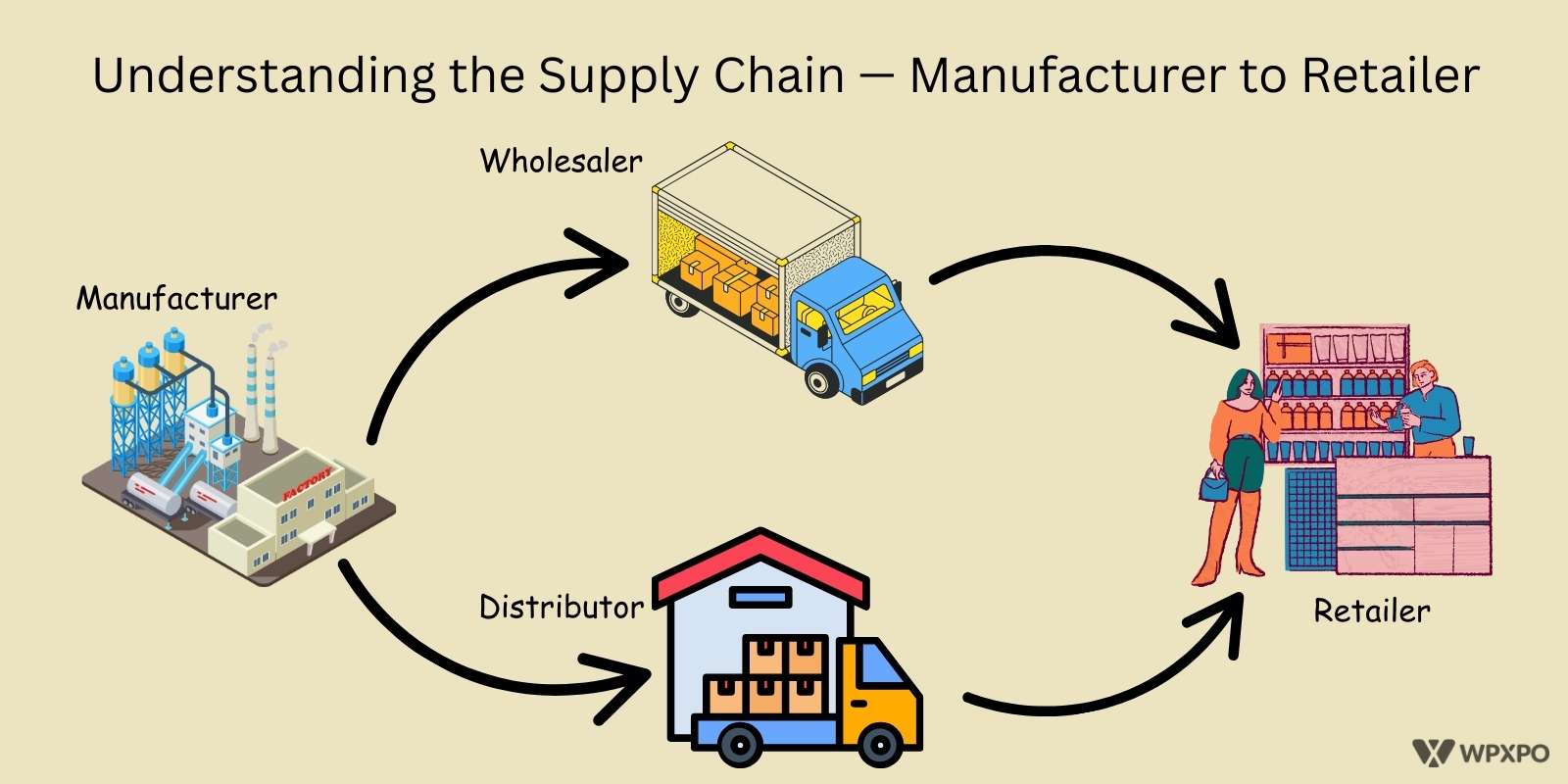
Manufacturer prices will always be lower than distributor prices because of the nature of the supply chain. The distributor makes money via high volume and is willing to accept a modest markup from retailers in exchange for more sales.
The wholesale price is typically based on several factors, including the cost of materials, labor, and overhead.
- The cost of materials is the cost of the raw materials that go into making the product.
- The cost of labor is the cost of the people who make the product, such as factory workers and designers.
- Overhead includes the cost of running the business, such as rent, utilities, and other expenses.
What Is Retail Price?
Retail price is the amount an end customer pays when purchasing a product from a retailer, either online or in a physical store. It represents the final selling price of a product and is usually higher than the wholesale price.
Retail prices include additional costs such as marketing, storage, operating expenses, and profit margins. Retailers may also adjust prices based on customer demand, market conditions, competition, and perceived product value.
For example, if a retailer purchases a product for $10 at wholesale, they may sell it for $20 at retail, depending on their pricing strategy and business costs.
Key Differences Between Wholesale and Retail Pricing
So what are the differences between the wholesale and retail prices? Let’s explain based on these contexts:
| Aspect | Wholesale | Retail |
|---|---|---|
| Target Audience | Bulk buyers, resellers, and businesses | Individual consumers |
| Pricing Strategy | Minimal markup, cost-focused | Higher markup, value, and brand-focused |
| Purpose | To sell in large quantities at a lower price | To sell smaller quantities at a profit |
| Profit Margin | Smaller margins focused on volume | Larger margins, often higher than wholesale |
| Price Factors | Production cost, bulk discount | Branding, demand, convenience, and value |
How to Calculate Retail Price from Wholesale Price
The relationship between wholesale and retail pricing is often explained using markup and profit margin. While these terms are related, they measure different aspects of pricing and profitability.
| Term | Formula | Meaning |
|---|---|---|
| Markup | ((Retail Price – Cost) ÷ Cost) × 100 | How much is added to the product cost to determine the selling price |
| Margin | ((Retail Price – Cost) ÷ Retail Price) × 100 | The percentage of the final selling price that becomes gross profit |
Example: Wholesale Price of $20
| Scenario | Calculation | Result |
|---|---|---|
| 50% Markup | $20 + ($20 × 0.50) | Retail Price = $30, Margin = 33% |
| 100% Markup | $20 + ($20 × 1.00) | Retail Price = $40, Margin = 50% |
| Keystone Pricing (2×) | $20 × 2 | Retail Price = $40, Margin = 50% |
A common mistake is assuming that a 50% markup produces a 50% profit margin. In reality, a 50% markup on a $20 wholesale product results in a retail price of $30 and a profit margin of only 33%.
Examples of Markup in Action
Imagine you’re a clothing retailer:
- The wholesale price for a T-shirt: $10 (this is what you pay to the supplier)
- Retail price for customers: $15
Your markup is calculated as:
Markup Percentage=(Retail Price−Wholesale Price/ Wholesale Price)×100=(15−10/10)×100=50
You applied a 50% markup to cover store overheads, branding, and profit. This helps sustain the business while providing value to the customer.
Again, imagine you’re a coffee supplier:
- Wholesale price for a bag of coffee beans: $15
- Retail price for customers: $30
Your markup is calculated as:
Markup Percentage=(Retail Price−Wholesale Price/ Wholesale Price)×100=(30-15/15)×100=100
You applied a 100% markup, which helps cover costs like roasting, packaging, and business operations while ensuring profit.
Common Wholesale and Retail Pricing Strategies
| Wholesale Pricing | Retail Pricing |
|---|---|
| Cost-Plus Pricing – Add a fixed margin to the product’s cost | Keystone Pricing – Double the wholesale price for retail sale |
| Volume-Based Pricing – Lower unit price for larger orders | Value-Based Pricing – Price based on perceived customer value |
| Tiered Pricing – Different price levels depending on quantity | Discount Pricing – Sales, promotions, or bundle deals |
| Market-Based Pricing – Set prices based on competitors or market rates | Psychological Pricing – Use prices like $9.99 to influence buying |
Businesses use different pricing strategies to determine wholesale and retail prices. The right approach depends on costs, competition, customer demand, and profit goals.
Learn more about Wholesale vs Retail with a real-life example and calculation.
Factors That Affect Wholesale and Retail Prices
Wholesale prices sound great until you see the MOQ: 100 units, 500 units, sometimes 1,000. MOQs are the real gatekeepers between ‘cheap per unit’ and ‘too much cash tied up in inventory.’
How MOQs Actually Work
| MOQ Level | Per-Unit Price | Cash Tied Up | Best For |
|---|---|---|---|
| Low (10–50 units) | Higher per unit | Low | Testing new products, small boutiques |
| Medium (50–200 units) | Mid-range | Medium | Growing stores with steady demand |
| High (200–1,000+ units) | Lowest per unit | High | Established brands with fast turnover |
Smart buyers negotiate MOQs down by committing to larger annual volumes, prepaying, or agreeing to slightly higher per-unit costs. The goal isn’t always the lowest per-unit price. It’s the lowest cost per *sold* unit.
The MOQ Trap New Store Owners Fall Into
A new store sees a $5 wholesale price on a $20 retail product and orders 500 units. That’s $2,500 in inventory before a single sale. If the product flops, the capital is gone. Better approach: start with the lowest MOQ, validate demand, then scale. Your article should warn readers that wholesale pricing only helps if the inventory actually moves.
Why MSRP Matters More Than Most Store Owners Think
MSRP (Manufacturer’s Suggested Retail Price) is not a suggestion. It’s a supply-chain control tool. Manufacturers set it to protect brand value, prevent race-to-the-bottom pricing, and keep retailers profitable enough to stock the product.
What Happens When You Ignore MSRP:
| Scenario | Short-Term Result | Long-Term Risk |
|---|---|---|
| You price below MSRP | More initial sales, higher conversion | Manufacturer cuts off supply, brand devalues |
| You price at MSRP | Steady margin, brand-aligned | Requires more marketing to differentiate |
| You price above MSRP | Higher per-unit margin | Customers compare to competitors and leave |
For new brands, MSRP creates a pricing ceiling. If your retail price consistently undercuts it, distributors may refuse to ship to you. If you’re a retailer, pricing below MSRP can trigger MAP (Minimum Advertised Price) policies that get you delisted from brand wholesale programs.
How to Position MSRP in Your Pricing Strategy
Treat MSRP as your reference point, not your target. Start there, then adjust based on your costs, audience, and competitive landscape. If you’re a brand setting your own MSRP, base it on real retailer margin needs: if retailers can’t make money at your price, they won’t stock your product.
Industry-Specific Differences in Wholesale vs Retail Pricing
Wholesale and retail markups vary widely across industries. Here are a few examples:
| Industry | Typical Wholesale Margin | Typical Retail Markup | Notes |
|---|---|---|---|
| Fashion | Low | High | Brand value drives pricing |
| Electronics | Moderate | Low–Moderate | Competitive market |
| Grocery | Very Low | Low | High turnover |
| Furniture | Moderate | High | Larger ticket sizes |
👉 Understanding these industry-specific patterns helps sellers set realistic margins, and buyers know what to expect when comparing wholesale and retail prices.
How can WholesaleX Contribute to Your Pricing
So far, you’ve understood the concept of wholesale and retail pricing, the differences between them, and the markup factor that distinguishes them.
Now, you can run your business keeping these in mind. But you need to manage the pricing rule that varies for your different customers, products, and business scales.
Yes, business is kinda complex, but don’t worry. You have got WholesaleX. It’s the most advanced WooCommerce wholesale plugin that comes with all the essential features that an ideal wholesaling store should have.
How can you use WholesaleX to control your pricing?
WholesaleX allows its users to override the built-in WooCommerce settings to customize them for different user roles and products.
Best Practices for Setting Wholesale and Retail Prices
To get the ultimate success from your business, you need to set the prices strategically. Here are some tips & tricks for you.
- Determine your costs first: Break down all costs from production and shipping to packaging and storage. This ensures that your pricing covers your expenses and generates profit.
- Factor in market demand: Up-to-date with what customers are willing to pay for similar products. Adjust prices based on demand.
- Consider your competition: Research competitors’ pricing. Differentiate your products based on unique value propositions, like better quality or customer service. Don’t just blindly copy your competitors.
- Use tiered pricing for wholesale: Offer discounts for bulk purchases to incentivize larger orders. Use WholesaleX to set quantity-based pricing rules.
- Regularly review prices: Pricing is dynamic. Adjust your prices periodically, especially if costs rise or if you notice shifts in consumer preferences or competitor pricing strategies.
- Experiment with different customer types: Apply different prices for different types of customers. It will help you get an insight into customers’ demands. You can use WholesaleX’s user role-based pricing strategy.
Key Takeaways
- Wholesale price is the amount businesses pay when purchasing products in bulk for resale.
- Retail price is the amount consumers pay when buying products individually.
- Retail prices are usually higher because they include operating costs and profit margins.
- Markup and margin are different pricing metrics and should not be used interchangeably.
- Factors such as production costs, MOQ requirements, demand, competition, and MSRP can influence both wholesale and retail prices.
FAQs
Why is the retail price higher than the wholesale price?
Retail prices are higher than wholesale prices because retailers add costs and margins to stay profitable: Operating costs, Marketing & packaging, Customer service, and Profit margin.
What is the ideal wholesale markup?
There is no specific range to define the ideal markup percentage. It depends on your total cost and the market conditions. It can differ in location, industry, and time.
What if I set the wholesale and retail prices the same?
Naturally, store owners don’t set the same pricing for wholesale and retail sales. However, if you do it whatsoever, you may face significant loss on either or both sides. If you bring your wholesale price to the retail level, both groups of customers will exploit your limit in the long run.
What is MSRP?
MSRP stands for Manufacturer’s Suggested Retail Price. It’s the price the manufacturer recommends retailers charge consumers. Retailers can sell above or below MSRP depending on demand, competition, and promotions.
Is the wholesale price always lower than the retail price?
Wholesale prices are lower than retail prices because wholesalers sell in large quantities and don’t add marketing, packaging, or customer service costs.
Final Thoughts
In conclusion, businesses need to understand the difference between wholesale and retail. Knowing the difference can help to set prices that will maximize their profits while still being competitive in the marketplace.
You can use that understanding to increase your B2B business. Also, you should set prices for different user roles to stay ahead of the game.
While you cannot do it by default, WholesaleX is a WooCommerce B2B, B2C, and B2B+C hybrid plugin to help you with the complete process.
You can ask your further queries in the comment section. 🚀
For more helpful tips, stay connected with our LinkedIn Newsletter.